Read More ...

Showing posts with label Reuse. Show all posts

Thursday, 12 November 2015

Zero Waste Holidays: this time for sure ;)


No, no. I am not crazy: I do not support holiday decorations being displayed at my local hardware store since September...

Nonetheless, the holidays are around the corner and my hardware store did remind me that last December, I vouched to be pro-active for this year's gift exchange. And that included letting those who will be exchanging with us know that we prefer experiences vs. more stuff. It seems early, but letting them know before they even had a chance to gather/buy objects for us, is key and all part of the “master plan” ;).

Here are some ideas, worth considering this holiday season:

GIFTS

-Offering "Experiences" in the form of a gift certificate or actual ticket, such as:
Classes at the local community college to develop a new interest
Movie ticket
Theme park season pass
Museum pass
Bowling night
Hotel night
Meal at a new restaurant
Treat to an ice cream parlor
My favorite for our kids: A year long subscription to a monthly surprise family activity (activities that I have in mind for the year, depending on our finances, include: kayaking, overnight at hotel with pool, ice skating, hiking to an overnight refuge, trampoline or indoor climbing center, science museum, gold panning in the mountains, crabbing, fishing, overnight on a houseboat, backpacking and overnight in the wilderness, fruit picking, sledding, overnight in a fire lookout, etc...) UPDATE: We call them SFA and inform you of our SFA of the month thru Twitter.

-Offering Services (your time) in the form of coupons, such as:
Professional expertise (I can offer simplifying and decluttering services for example)
Hand labor (planting a tree, painting a room for a new baby, fixing a deck, lawn mowing)
Babysitting
Services are great for kids to give (one sibling could take another sibling's chore for a period of time)

-Offering consumables in a reusable jar (to simplify, pick one project and make a large quantity):
Homemade cookies, cake mix, herbal tea, jam, pickles, sugar/salt scrub, balm, lemoncello, toothpowder (with recipe attached)
Or a bulk item (cornichons, olives, maple syrup, toffee pecans, chocolate malt balls).
Homemade candles, soap, and paper are also great “out of the jar” alternatives.

-Shopping your home: Regifting (and there is nothing wrong with that!) or giving something you already own when you know for a fact that the recipient will appreciate it. I have a dedicated drawer for that purpose, it gets filled and used all year long.

-Buying used at a thrift store or on Ebay. For the latter, make sure that the item is used by checking the “pre-owned” option in your Ebay search.

-Using the smallest gifts and bulk treats to fill stockings instead of stuffers.

-Selecting gifts that tighten family bonds (family “experiences” or used board games for example).

-Greening Santa: Santa brings only one gift per family member. It comes unwrapped because Santa cares about the environment and his gift is easily spotted among the other (family) wrapped presents. The benefits of the “one special present” go beyond the obvious...equality among children of different financial background, modesty, smaller wish lists, less stress on Santa!

-Avoiding the mall until January: Not only better for your carbon footprint (driving, new stuff purchased), but also your sanity, stress level, creativity and wallet. Challenge yourself to do without!

GIFT WRAPPING:

-Purchasing or making reusable gift bags from fabric scraps (or redesigned lone socks and pillowcases) sends out a green message to your recipient. The attached tie also eliminates the need for a loose ribbon.

-Purchasing or making Furoshiki squares (28x28) and learning some easy-to-follow tricks on how to artfully wrap in fabric. The elaborate knots and tucks also eliminates the need for a loose ribbon

-Using a gift to wrap another. A t-shirt, a sweater, a kitchen towel can wrapped just about anything and serve a double duty (a gift and wrapper in one).

-Reusing what you already have, if lacking the previous wrapping alternatives: Papers from your recycling bin (your kids can quickly paint some designs on them), children's artwork, a washed meat wrapper, newspaper or paper bag if you are still allowing these into your home ;).

-Using leaves as gift tags or anything in your recycling bin that can be cut into a small rectangle.

DECORATION:

-Reusing a potted plant that you already have or purchasing one that can become your yearly alternative to the Christmas tree. I use a tall topiary. The first year, it seemed odd (an adjustment), now we can't imagine going back to regular trees.

-Vouching to not buy yet another ornament. We rediscover our holiday decorations every year when we unpack our dedicated crate, and we always have enough!

-Making consumable decorations such as a homemade gingerbread house (with treats available in bulk) or a string of popcorn as garland (feeding it to the birds after the holidays, thanks to Dori and Val for the suggestion) for as long as the kids enjoy participating in the making.

-Using seasonal whole fruit, whole vegetables, yard clippings or leaves to adorn the table.

CARDS:

-Emailing your holiday wishes. Last year, I made plantable cards (it took me a week of work and lots of stamps), this year I will email our wishes. It's the thought and the content of the message that counts.
-Sending the cards that you do receive for reuse (as mentioned last year) to St. Jude's Ranch Card Recycling, 100 St. Jude Street, Boulder City, NV 89005. It supports a good cause too!

-Choosing recycled and recyclable materials, if you do choose to send out a card. Keep in mind that photo paper is not recyclable.

TRADITIONS:

-Supporting your Zero Waste efforts with meaningful traditions vs. the wasteful, stressful and complicated activities of the season (Zero Waste not being just about stuff management).

-Being kind to yourself by simplifying your traditions: Consider less cooking, using your everyday china and glasses if your fancy set requires hand-washing, eating out, going for a hike if weather allows.

-Being kind to others by:
1 - Being kind to yourself,
2 - Freeing a parking spot by avoiding the mall ;)
3 - Applying “Acts of Kindness” to your holiday season: participate in a homeless soup kitchen, sing carols in your neighborhood, write a Thank You card to someone whose services you appreciate (your friendly baker for ex.?)...

To hear more about Zero Waste Holidays thru a thick french accent (I hope Santa will think of getting me an accent reduction class), you can check out my recent podcast on More Hip than Hippie.

I dream of having more than an "almost Zero Waste" Christmas. With simplifying and adequate preparation, I truly believe that my dream can come true. Last year, I dreaded the season, this year I feel ready and excited to face it! Bring it on!

Any more ideas to reduce waste during this coming holiday season?

Friday, 9 October 2015

Crappy Month and Wasteful Repairs.

Boy did we have a crappy, wasteful month. People say “shit happens”, but a whole truck load fell on us these past few weeks. Not a pretty picture, I realize ;).

It all started on a Thursday evening.

After a long day of work and dinner time fast approaching, I had been faced with a practically empty refrigerator (I grocery shop on Fridays), and challenged once again to make dinner with the few bits scattered in the refrigerator. I had managed to make the best of the one tomato, chunk of cheese, lonely egg and last cup of flour - and had proudly put together a tomato quiche. (These are my proudest moments in the kitchen: Making something out of “nothing”. I even surprise myself sometimes). But we never not got to savor the pretty quiche that night... My gas range would not turn on. I tried resetting its power, but in vain. I would have to wait until the next morning for further repair action (the service center being closed for the day of course). So there we were: Hungry, kids showered and in PJ's, Scott pacing, 7:30pm and nothing on the table.

Confronted with six hungry desperate eyes, asking “What's for dinner?”, I called in for my 1st takeout pizza ever (I am 36 years old by the way and have been avoiding takeouts, since I started home cooking 18 years ago). I felt all goofy on the phone, not knowing the protocols of ordering a pizza (if there are such things), but I did not forget to request “no Lilliputian table” (you know the white plastic piece in the middle of the pizza to keep the box top from sticking to your toppings). Within 20 minutes the extra large pizza and its extra large box crossed the Zero Waste Home's threshold. Gasp.

Wait! Don't leave the blog yet. While we were gone this summer, our town finally started City Compost (the best "sustainable" thing that has happen to our town since we moved here three years ago). We are now able to compost our meat, fish bones, butter wrappers... and the emergency pizza box. Not that I condone the compostable cardboard takeout container, which in our case only had a useful life of literally 5 minutes (ugh)...

The next morning, I called the service center for the range. After a few questions, they recommended that I call in a repairman. I did. But since labor day weekend was about to start, the repairman could only come on Tuesday.

A few BBQ, salads, and sandwiches later, came Tuesday with the repairman. Then, Wednesday with two repairmen, Thursday with a handyman, Friday with a new repairman, another stove-free weekend, and Monday with a plumber. And on top of all expensive and unexpected gas repair bills, a whole lot of trash: the repairman's takeout soda cup and straw, the repair parts packaging, the broken pieces... And the old gas pipes. Did those get recycled? I did not even ask, too frazzled and mad at our original contractor for screwing up the oven's installation in the first place.

It took a week and a half to get the oven up and running again. And when we thought we were done with repairs, more (completely un-related) problems came... It's as if we had been cursed by the unavoidable powers of Trash Evil.

- Our kitchen sink backed up and in spite of our unclogging efforts, all the original piping from the sink to the sewer had to be replaced. Repair: New copper piping outside, and new ABS piping under the house, glue, caulking, paint and parts... Landfill: Completely clogged metal piping (empty caulking tube is a #2 and went into the recycling)

- Our entertainment center fan stopped working, and without it our sound system is unusable (it gets too hot in its enclosed space under our stairs). Repair: New fan in a cardboard box and plastic packaging. Landfill: Fan parts (I hope to recycle the motor at an e-waste station).

- A corner of our marble counter broke off! Repair: Epoxy putty. Landfill: Double plastic packaging of epoxy putty (packaging within packaging).

- Our hair trimmer for our DYI haircuts broke. Repair: New hair trimmer in cardboard box. Landfill: Plastic parts of hair trimmer (will take the motor to the e-cycling also).

- Then the plastic casing of Scott's beard trimmer broke (No seriously, the hair trimmer just went out - and now the beard trimmer!). Repair: New beard trimmer. Landfill: Plastic part of trimmer and plastic packaging of trimmer (will take the trimmer motor to e-cycling also).

- We noticed our dining chairs scratching the hard wood floors, they needed new pads. Repair: Felt pads on chair bottoms. Landfill: Packaging of felt pads (FYI - The next day I found some in bulk. Bummer!)
- One light bulb went out, then another, and another: that's three light bulbs in one month (and I am trying not to be paranoid here). Repair: Three specialty light bulbs (two in plastic packaging, one in cardboard). Landfill: Three light bulbs and two plastic packages.

- We noticed that some paint had bubbled up on the side of the house. Repair: Sand and paint the siding before the rainy season. Landfill: Sand paper and paint roller.

- I dropped my all purpose shears, the plastic handle completely shattered. Repair: Get a new sturdier pair of shears. Landfill: The broken shears (I could not get the metal off the plastic to recycle the metal).

- We got a flat on a practically new tire, sometimes they are repairable, in this case (because of the location of the puncture on the side of the tire) it was not. Repair: New tire (the tire shop said that they would recycle our old tire...) Landfill: The greasy hand rag (a piece of retired tee-shirt) we used in changing the tire.

- Our remote control ran out of battery (the last disposable batteries we had). Repair: A new pack of AAA rechargeable batteries. Landfill: Plastic packaging of new batteries.

When people now ask me what the packaging the hardest to avoid in a Zero Waste Home is, my answer is: Hands down, home repairs. No doubt about it.

Hardware stores might have some good bulk items: Loose screws by the ounce, loose plumbing parts, irrigation parts, felt pads, cable by the foot, all scattered in different stores around town (oh, do I wish there were all in one place). But they also have some of the worse packaging. Come on Ace and Home Depot, can't you ask your suppliers for alternatives to the plastic packaging everywhere? Do felt pads, batteries, CFL's, and a single tiny junction box cap need to be displayed in this frustratingly-hard-to-open hard shell plastic?


Here's to a better month ahead!

Monday, 28 September 2015

How to Get Started

I recently wrote an article for Yes! Magazine, which included 10 tips for a Zero Waste Household. I thought I would share them with you. These tips happen to summarize the lifestyle perfectly and are a great (and much needed) "How to Get Started" for the blog. It's a good review for those of you who are already well down this path too.
____________

The zero in "zero waste" makes it sound scary and hard to achieve. It is actually not as as hard as it seems, and it is as simple as following these Five R's, in order:
  • Refuse what you do not need.
  • Reduce what you do need.
  • Reuse by using reusables.
  • Recycle what you cannot refuse, reduce, or reuse.
  • Rot (compost) the rest.
Refuse
1. Fight junk mail. It's not just a waste of resources, but also of time. Register to receive less at dmachoice.org, optoutprescreen.com and catalogchoice.org.
2. Turn down freebies from conferences, fairs, and parties. Every time you take one, you create a demand to make more. Do you really need another "free" pen?

Reduce

3. Declutter your home, and donate to your local thrift shop. You'll lighten your load and make precious resources available to those looking to buy secondhand.
4. Reduce your shopping trips and keep a shopping list. The less you bring home, the less waste you'll have to deal with.

Reuse
5. Swap disposables for reusables (start using handkerchiefs, refillable bottles, shopping totes, cloth napkins, rags, etc.). You might find that you don't miss your paper towels, but rather enjoy the savings.
6. Avoid grocery shopping waste: Bring reusable totes, cloth bags (for bulk aisles), and jars (for wet items like cheese and deli foods) to the store and farmers market.

Recycle
7. Know your city's recycling policies and locations—but think of recycling as a last resort. Have you refused, reduced, or reused first? Question the need and life-cycle of your purchases. Shopping is voting.
8. Buy primarily in bulk or secondhand, but if you must buy new, choose glass, metal, or cardboard. Avoid plastic: Much of it gets shipped across the world for recycling and often ends up in the landfill (or worse yet, the ocean).

Rot
9. Find a compost system that works for your home and get to know what it will digest (dryer lint, hair, and nails are all compostable).
10. Turn your home kitchen trash can into one large compost receptacle. The bigger the compost receptacle, the more likely you'll be to use it freely.

And remember: You're not alone. Come here to share your experience with like-minded individuals, check out the tips page and post your questions in the forum's page.

Thank you for being open to change!

Wednesday, 3 June 2015

Repairing

Still working on my book full time... please forgive my long absences and short blog post!
I have a fun project starting in a couple of weeks, but until then...

I wanted to share my last repair with you.

No matter how much we (first) Refuse, and (second) Reduce, we constantly face the results of today's poor designs and manufacturing. Repairing has been an important element of our Zero Waste lifestyle, since it represents one the many facets of REUSE. But I am so proud of my most recent achievement!


Leo fell in love with a seconhand jacket but the cuffs were worn: I repaired them with the elastic bands of a pair of worn-out socks. It literally took five minutes to accomplish, and it made one happy boy!

Torn cuff


Worn-out sock

Repaired cuff

What did you last repair?

Saturday, 30 May 2015

9 Reuse ideas for Cardboard in a Zero Waste Home

My thoughts on cardboard use, reuse, and recycling, through the interview questions of a cardboard manufacturer.


How important do you feel reusing recyclable materials like cardboard is today?

For the sake of the environment, it is important to prioritize reusing before recycling. The recycling process takes energy and resources; that loss can be avoided with reusing. In reducing our waste, our plastic consumption has been almost completely stopped (the only plastic product we buy on a regular basis is my husband's contact lens solution). Thanks to its weight and recyclability, cardboard has replaced many of the plastic items that we used to buy. For example, our kids use cardboard school binders instead of the laminated kind. 


Would you personally prefer to recycle cardboard in the conventional way (e.g. using local recycling facilities), or would you rather find a way to repurpose the cardboard for something else around the house? 

To lead a Zero Waste lifestyle, my family applies 5R's in order (Refuse-Reduce-Reuse-Recycle-Rot). Reuse precedes Recycle, so we prefer to repurpose the cardboard that we cannot first Refuse or Reduce. 


Do you think people today make enough of an effort to reuse and recycle in general?

Your question is timely. I visited a waste transfer station last weekend and watched people unload cars and trucks full of (what they consider) "rubbish". The material that jumped out at me as being the most prevalent and yet, widely recyclable, is cardboard. Our society makes it too easy to underestimate the value of our planet's resources but consumers need, and can easily, rise above this needless waste. 


What would be your top tips for reusing cardboard? Are there any specific things cardboard can be used for in the home?

Broken cardboard school binder dismantled for reuse
Since we exclusively buy food in bulk from the health food store and  buy household goods secondhand mostly from the thrift store, the little cardboard that makes its way into our home is from our kids' school binders and toilet paper rolls. We also receive boxes from products that we've sent to manufacturers for repair and eBay purchases (we use this site for specific items and request shipping materials to be cardboard or paper). If we don't have cardboard on hand and need some, we go dumpster diving!

Here are ways to reuse cardboard in a Zero Waste Home:

Shipping something: When you receive a parcel, put the box aside to use for your own mailings. After all, your purchase likely paid for it, so why not reuse it instead of buying a new one at the post office? I have dedicated a spot for this in my office to make it easy and automatic to reuse the ones I get. The trick here is to not get overboard: Only keep a handful, and reuse the rest in other ways (see below) or donate them. In the US, UPS accepts them, along with bubble wrap and other packing materials, for reuse.

Padding a parcel: Speaking of mailing... Cardboard can also be cut to the size of an object to protect it during shipping. It is a durable and sustainable alternative to bubble wrap or plastic-padded envelopes (to emulate the latter, simply slide two pieces of cardboard in a paper envelope!).

Craft making: Why buy card stock when the very same material sits in your recycling bin? Our family no longer buys or stores art materials at home. When we need some for a school project, we reach into our recycling bin and use whatever bits of paper or cardboard we can find. And if a teacher asks for a poster board, we unfold and cut a box to size.

Packing for a move: If you're planning an upcoming move, start collecting large boxes in a spare room now. If not, make the ones you still have from your last move, available to others by posting them on a classified ad (on Craigslist for example). People who pack for a move themselves are desperate to find free boxes and would be happy to make use of yours. 

Moving furniture: Rather than carrying heavy pieces of furniture, set them on cardboard and slide them around. This will save your hardwood floors, and more important your back! 

Donating your stuff: Our household has been refusing plastic and paper bags since 2008, so when time comes to donate the kids overgrown clothing, we keep an eye out for a cardboard box to pack and transport our donation to a local charity. Boxes are much sturdier than bags, and with their flaps paper-taped up, I can pack them high and tight!

Protecting your floor: Whether you need to protect your floor from a paint job, heavy traffic during a remodel, or your toddler's food throwing skills, cover the area with unfolded cardboard boxes. But remember: if food comes in contact with cardboard, it's best to compost it (vs. recycling it).

Storing your stuff: Before the digital age, shoe boxes collected family photos, but cardboard boxes of different sizes are still predominantly reused for storing things. Don't underestimate other cardboard forms though: your empty toilet paper roll can too serve you well. Keep spare extension cords neat and tidy by coiling and sliding them into separate rolls.

Playing pretend: Give a child an empty cardboard box and you'll open a whole imaginary world for him/her. It can be more than a house or a rocket ship: my son's friend, Camilla, once went to a costume party dressed as a gift! And this B-boy would use it to start off breaking battle;)


What cardboard item can't you avoid, and how do you reuse it?

Saturday, 23 May 2015

Cleanliness Standards Revised

"U.S. consumers spend nearly $1 billion a year on antibacterial products that aren't necessary" according to Mother Nature Network.
In our increasingly germa-phobic society (where people go around carrying Purell on their key chains), we are pounded by advertisement for disposable products promising a cleaner, thus healthier life: Tissues, bottled water, antibacterial wipes and the latest… Kleenex's Disposable Hand Towel (!?).
For such products to make it on the market in 2010, proving that some manufacturers are either clueless about their role/impact on the environment or simply ignoring it for the sake of their wallets, is one thing, but perpetually preying on our primal fear of getting sick and misleading us with bogus information is another (one of the reasons why I do not miss TV).
"Regular washing of bathroom hand towels does not ensure clean hands." Kleenex says...

With absurd quotes like this one, coming from (or shall I say, sponsored by) an industry leader, no wonder why our society has trouble letting go of the disposables... we have come to believe that a higher standard of cleanliness would make us healthier.
The cleaner, the better...
But have we reached the point where we're too clean for our own good?

It is apparent that since disposability has hit the market and entered our homes, our standards of cleanliness have gone extreme. Sadly, living up to these made up standards and fitting "socially acceptable cleanliness" are costing us our health (killing the good germs) and that of our planet (depletion of resources through production and pollution through disposal).
Finding the right balance between squeaky clean and hygienic seems to be in order.
We have been steered away from reusable products, and led to think that these were somehow gross, so here are 10 standards, revised for TheZeroWasteHome:
It's OK to:
  1. Actually, it's not just OK, it's a must...: Switch from your antibacterial products to natural soap (Don't breed the "superbug").
  2. Wear clothes more than once: I admit, it took me a few months to get used to it. Your clothes should not make you self conscious if they have stains or smell, so use your sense of smell to guide you if you're stain free.
  3. Wash your hair every other day: a little cornstarch can serve as a dry shampoo (sprinkle on your hair, massage in, and brush out) between washes.
  4. Let it mellow, if it's yellow: I confess, I do not let it mellow and flush when I have people coming over.
  5. Blow your nose in a handkerchief: tissues are only a recent invention, people lived without them before us. And remember, a hankie being a personal item it is used only for you, so they're your own germs.
  6. Use the Diva Cup: Get over your skepticism and fear of the cup; if you can insert a tampon, you can insert the cup.
  7. Hold off on your weekly sheet washing: If you went to college, you know your immune system survived less frequent washes. In Europe, people air out their sheets between washes. The word "sanitizing" is actually synonym of "airing out", in french crosswords.
  8. Use and reuse a cloth napkin between washes: We use napkin rings to tell ours apart: so simple and yet, it helps us go longer between washes (once a week).
  9. Clean your house with vinegar, castille soap, baking soda and reusable cloths (instead of Comet, 409, Windex, Dawn, Scrubbing Bubbles, Tilex, Lysol, bleach, etc...): Seriously, that's all you need to keep your house clean.
  10. Accept a stain on the kitchen towel that you just washed: Stop fighting stains on items that are meant to be stained. Kitchen towels don't have to be spotless.
I have to say that I used to be obsessed with the whiteness of my kitchen towels, worried that my cleanliness would be judged by their spotlessness. I then realized that the impact of repeat washes and bleach, were not worth it, and that my time would be better spent elsewhere.
By lowering our modern squeaky clean standards, we can refocus on what matters most... spending time with our loved ones, cooking healthy food, or lending a hand to save the Earth.
Note to Kleenex: In a house where none of your disposable hand towels are to be found, we've amazingly survived yet another winter, free of colds...

Friday, 24 April 2015

The Zero Waste Closet

Last week was April 15th! For most it meant tax day. For me: Biannual clothes shopping day. The day I refresh my worn out basics and add some zing to my wardrobe. I wait and prepare for it for months at a time. I love fashion and I only shop twice a year: April 15th for spring-summer, and October 15th for fall-winter.

Before each spree, I visit the library and go through magazines to get inspired and educate my eye. This is a system that I have lived by for the past eight years.
But, please... don't blame me for being tempted by fashion, symbol of a disposable and ephemeral closet: I graduated from the London School of Fashion, and still enjoy expressing myself through dressing. And as long as my shopping habits follow my sustainable ethics, isn't it alright to be fashionable? What can I say: I do care about my looks, regardless of the Zero Waste lifestyle, sadly associated with careless / carefree clothing. Did I mention that one does not need to conform to a certain fashion style to be a Zero Waste advocate?…My personal fashion sense is rather about wearing exciting, one of a kind, USED pieces to make my everyday more exciting.

I can see some of you cringing at the idea of thrifting already. "I can't find anything in that mess", or "Oh! I can't take the smell in thrift shops", people tell me... It's true that the items in the shop have lost their smell of off-gassing plastics and that these shops don't have perfume in the air (department stores) to cover it up. Isn't it sad that most people prefer to shop in a store that reeks of plastic because the smell is associated with new things, the high of shopping and consumerism? You know what I am talking about if you have practiced department/new store abstinence before. It is like discovering the true smell of your house after a long absence... Well the true smell (or is it the phthalates?) of those new stores actually makes me nauseous. And if the term "used" bothers you, call it "vintage". Somehow vintage stores, although they also only carry used items, have a better reputation.

But what I love most about thrift and vintage shopping is the hunt for the unusual clothing, the minimal price tag (where I shop they use a piece of paper stapled to the garment as a price tag), and the carbon footprint redemption, of course… This is where you choose a garment for its fit, not its tag or brand.

Here is my system:
  • I stick to minimal closets: My boys, for example, have a set of 4 pants, 8 shirts, and a dressy outfit for each season. I'll spare you my wardrobe list.
  • I keep a minimal shoe closet: I have paired it down to just 6 pairs of shoes: slippers, boots, ballet, medium heel, high heel sandal, and sandals. For the kids, I buy athletic shoes second hand, and when worn out I take them to Nike "Reuse a Shoe" program. (At the rate that my little one goes through sneakers, we wait to fill a bin before taking them in). They also own a pair of dress shoes, flip-flops and slippers.
  • I own only a small selection (3) of purses: 1 everyday/evening wrist wallet, 1 small foraging messenger bag and 1 work bag (to fit my computer).
  • I keep an updated inventory of my closet, made up of neutral colors and exciting season-less essentials. On that same excel file, I highlight the items that I wore out (holes, tears or stubborn stains) and need to replace on the next shopping trip.
  • I shop twice a year: It avoids compulsive buys, keeps us out of the mall. (We actually only shop once a year for my husband).
  • I shop at second hand stores mostly: I believe in reusing before buying new organic clothes. This season, the new items I purchased were a pair of sandals (could not find a basic secondhand pair) and a bra. The rest I bought at the thrift shop for $40 (I can proudly say, it is a record low)
  • If I do get a new piece, I make sure that it is good quality, and only carries minimal tags (I leave the shoe box at the store). Patagonia, I hear, recycles some of their garments to make new ones.
  • I am ruthless on fit, it is as simple as: "If it doesn't fit, I must acquit!"
  • I bring a basket: Too often we think about the reusable bag at the grocery store, but don't apply it to other stores.
  • I put it back on the market before it goes out of style: If, for some reason, I do not wear a specific piece of clothing for a month, I give it to a friend or Goodwill. Otherwise I end up with a closet full of nothing-to-wear. Keep it on the market and share it while it's hot!
  • I keep some of my worn out clothes for rags (duh), but I label the rest as "rags" and take it to Goodwill for recycling. Call your local Goodwill to confirm their participation in the program.
  • With sewing, I have been able to save many outfits, with only a few stitches (shorten a hem, add an elastic or change buttons...)
  • I take it to the tailor, if something is out of my technical expertise (I recently had to take a coat in, the fabric is too thick for my machine)
  • I keep handkerchiefs handy in my closet and purses.
  • TMI: I keep vitamin E balm next to my sandals to add shine to my polish-free toes.
And you know what the bonus was on this last thrifting spree? Finding a two liter Le Parfait jar for only $2. Yoohoo!

Sunday, 22 March 2015

Fashion Friday: Another Way to Wear the LBD


What a busy last two weeks! They went so fast that I failed to post last week's Fashion Friday.
This is my pick for this week. I wore this from an interview to the grocery store to a girl's night out, and my whole (secondhand) outfit cost $14...


Sunday, 8 March 2015

Mini Wardrobe Fave: The LBD


It's already Friday! Sorry for not being very present on the blog this week. Things have been quite busy on the Zero Waste Home Facebook page -Thank you FB fans for your overwhelming response to the pictures that I posted. I have very much enjoyed sharing my simple lifestyle with you and getting to know you better!

Today, I am sharing an obvious, yet important element of a capsule wardrobe: the Little Black Dress. I bought mine off a $2 rack at the thrift store three years ago, and if you've followed my media coverage, you've probably noticed that this dress is my go-to-outfit when I do not know what to wear ;). This dress is super versatile; it can easily be dressed up for a party, or down for the beach. I have had so much fun playing around for these photos, I hope they inspire you to play around with your LBD too!


Worn alone

With a white blouse underneath

On top of jeans

Topped with a striped long sleeve (Max's hat on my head)

Worn as a top, under a leather skirt

Belted at the hips 

Paired with flares

Topped with a nude tank

Under an overcoat

Topped with a white blazer 

Worn as a top, under a colorful skirt

Belted at the waist

Happy Friday!

Sunday, 1 March 2015

Fashion Friday: Wearing PJ's out!

Happy Fashion Friday!

A minimalist wardrobe sometimes requires you to think outside the box in order to maximize the use of the few pieces you own. My only pair of PJ's is black and silky but completely opaque, making it descent to wear out. So this week I thought "why not?".

Wearing the top with flare pants

Wearing the bottom with white tee and blazer

How Zero Waste is my outfit?
All (PJ's, sunglasses, bracelet, necklace, blazer, white tee, black flares, nude heels and purse) were purchased used. The sandals were a gift from my mom four years ago -I could not refuse them;)

Sunday, 22 February 2015

Fashion Friday: Shorts in Winter

Today is Fashion Friday on the blog! This week I winterized my one pair of shorts -to California weather standards;)


How Zero Waste is my outfit?

Shorts: Purchased from a thrift store 4 years ago. They were a boy's pair of dress pants that I
shortened ;)
Black thermal, Animal print scarf, Sunglasses and Boots: Purchased as-is from the thrift store within  the past 3 years (I have waterproofed my boots for the rain - How-to in my book!)
Black tights and leather jacket: Purchased new within the past 3 years (before I made the vow to only buy secondhand). As you know, I don't like to mention brands, but my one pair of tights, Target's Merona premium opaque, have outlasted any pair that I have ever owned (3 winter seasons with several wears a week later, they are still going strong!).

Wednesday, 18 February 2015

How-To: Darning


Darning was, with canning, one of those old fashioned techniques that intimidated me; it just sounded hard. It's only after our family evolved into a Zero Waste household and our toes started peeking through socks that I decided to give it a go. I was amazed to find out how straightforward and forgiving darning really is.  If you've never tried it, follow this simple tutorial, and you won't need to collect worn-out socks for dusting again (how many do you really need anyways?), but keep them where they belong: On your feet!


What you need: A garment with a hole, a large needle threaded with a yarn color to match your garment, and an object with a rounded side (e.g., when I repair a sock, I use a cup).


Place the object under the hole


Run horizontal stitches over the hole, making sure that they cover an extra 1/2" on all sides 

Weave rows of stitches perpendicular to the previous ones.


End your last stitch inside your garment and cut the yarn. When fixing socks, do not make a knot (comfort).


Pat yourself on the back! You've saved a piece of clothing and your budget!


Friday, 13 February 2015

Zero Waste Essential: The Mending Reflex


Repairs are an essential part of our lifestyle. Things are bound to break or get damaged in one way or another, but mending can extend the useful of our necessities. In our prior life, all the examples below would have ended up in the landfill. Today, our "landfill reflex" has turned into a mending one. Whether it involves scrubbing, sewing, gluing, darning or nailing, there is almost always a solution for a break or damage - and boy does it save money!

Here are examples of my recent projects:


Scrubbing: I thought my slipper was ruined when I found a smear of dried up paint on the calf after a wall paint touch up. My scrubber once again came to the rescue and my slipper is now like new.

Sewing: After 12 years, the padding of Scott's snowboarding helmet disintegrated and dropped black powder on his face with each use. I cut and sewed a replacement pad into a wornout wool sweater that I have felted for such repairs. The helmet is more comfortable that it used to be!

Gluing: The bristles of my scrub brush were ready for the compost, but the handle was still usable, so I transferred and glued dowel and handle onto a new brush (glue recipe in my book!)

Darning: My grandmother was a queen at it, and I don't think I do as good a job as she did, but hey, the result still works (Darning tutorial in an upcoming post)

Nailing: Leo's flip flop gave out, a nail across the loose bit now holds it in place. It's been 9 months and it's not budging!

How have you broken the landfill reflex?

Thursday, 22 January 2015

Zero Waste Home essential: A cobbler


Today, I share with you another Zero Waste essential for my household: A good cobbler.

Located only a couple of blocks away from my house, Misak, better known as Tony, is key to achieving Zero Waste in my wardrobe. He is not only my partner in extending the useful life of my shoes, but he also meets my needs for a short turn-around, knowing that I only own six pairs of footwear. And, his service always comes with a smile. He is actually more than your regular cobbler, his life is to be featured in a documentary! Sadly, shoe repair is a disappearing trade, yet this work is part of the grand scheme of the Zero Waste future. Do you have access to one in your town?


My heels before handing them out to Tony

Another pair saved!


Friday, 16 January 2015

Zero Waste Kitchen


Friends have asked me to blog about what they can do to reduce their household waste. I think its time that I wrote about what we did and are doing in our house. Let's start with the kitchen (I'll use the 1st person, because that's really my territory):

- I do not buy single-use products: They are not worth it (paper towels, garbage liners, wax paper, aluminum sheets, disposable plates, cups, etc...). I swapped paper towels for reusable rags, I chose microfiber because they do an amazing job and have eliminated many cleaning products (see Zero Waste Cleaning). I swapped sandwich baggies for kitchen towels (I made a bunch from an old french linen sheet). We dropped garbage liners all together, the wet items in waste are mostly compostable anyways (tomatoes for example). If you don't buy these disposable products, you will realize that you can very easily live without them. Try it for a while.

- I buy in bulk or at the counter (see Zero Waste Grocery Shopping), I bring reusable bags and jars for oils, vinegar, dry goods, spices, nuts, meat, fish, cheese, olives, etc.: no disposable or recyclable (because so little of what goes into the recycling can actually gets recycled) food packaging and containers allowed in the kitchen. I shop at my local Whole Foods, Mill Valley Market, Good Earth, Berkeley Bowl, New Leaf, Rainbow Grocery in San Francisco (the mecca) and seldomly Safeway (they have never questioned a jar at the cheese counter).

- "Exception makes the rule" above: butter (see below) and special occasion wines (we reuse some of the bottles for refills and recycle the corks). Our everyday wine we do get refilled at a local winery (Guglielmo Winery). 1-10-11 update: we get out wine refilled in French or Italian lemonade bottles that have flip tops (.75l) to reduce our cork usage.- If an item is not available in bulk, I make it (yogurt, mustard, soy milk, salad dressing, pickles, hot sauce, jams, OJ, hummus, sometimes cookies). I will post recipes for these later. 1-10-11 update: For simplifying reasons, I do not make yogurt or soy milk anymore. I purchase St Bemoit yogurt instead, which reuses their containers (deposit at the store).- If I can't make an item or am too lazy to go that route, I find a supplier and show up with my jar (ice cream shop, candy store)... I filled my travel tea mug with ketchup from a fast food joint once. 1-10-11 update: We get our beer refilled at the local brewery (you buy a growler and get it refilled at the bar when needed), but that only really works when you are ready to drink down 2 liters of beer at once (it will get flat overnight).
- I buy eggs and produce (I bring reusable produce bags) at the farmer's market (Mill Valley Friday Farmer's Market), the egg carton is reusable there and you won't likely find your cauliflower or cucumber shrink wrapped, your potatoes in a plastic bag, your fruit with stickers on them, or your carrots bundled with a plastic/metal tie.

- If a veggie is going to be out of season and I have learned through the past year that I cannot live without it, I'll can it (instead of getting a store-bought can later). Example: Tomatoes! (that's the only veggie that I really can't live without).

- Whole Foods bakery will bake 15 baguettes at a time for me and put it into my large bread bag (to bypass the pesky baguette sleeve), I throw them in the freezer as soon as I get home. 1-10-11 update: I freeze enough baguettes to last us a week (these days, it's 10), cut them in half and freeze them in a pillowcase.

- We use yummy tap water in stainless steel bottles: not only great to travel with but also to avoid chasing and washing the tons of empty dirty glasses that I used to find on my counter.

- I choose a compostable cleaning brush (a wooden one with natural hair), and a compostable scrubby (I have used loofah or have knitted a scrubby from sisal twine). 1-10-11 update: I substituted the latter for a stainless scrubby, it gets the job done easier.
- I buy in bulk both castile soap as a dish/hand cleaner (Dr Bronner's) and baking soda as a scrubber (in a stainless Parmesan dispenser). I do still buy my dishwasher detergent (Seventh Generation) in a box, because the one that I have found in bulk is liquid and comes out of a gallon size plastic container. I believe that powder in a recyclable cardboard box is greener (plastic only gets recycled once, cardboard many times). 1-10-11 update: I now buy my detergent in bulk at Good Earth (see Bulk Shopping in and around Mill Valley).- I have turned what used to be our trash can into a big compost keeper (it makes composting easy and at the reach of the kids, before we take it outside on a weekly basis), I use another one for recycling and a tiny bucket for trash (items to put on my to do list of improvements- the less I have in there, the more free time I get!). 1-10-11 update: The tiny bucket took up too much room, I now store our trash items in the under-counter paper towel holder.

- I store all our food in Le Parfait french glass canning jars (not just because I am french, I promise). No more plastic leaching Tupperware. I now have about 150 of those in different sizes (I am addicted). I use them for canning, storing, freezing, transporting, they are so versatile and interchangeable, just love them.

- All leftovers get eaten as-is, reinvented in new dishes, or frozen (the dog sometimes gets some too!) and I make stock from meat bones and veggie scraps.

- I keep my kitchen drawers and cabinets very minimal, with strong metal accessories (no plastic), the stronger and less you have, the less will break, the less will end up, well... you know where. I also have allowed only 2 I-cannot-live-without small electrical appliances: a toaster, and an immersion blender (with chopper and mixer attachments). I agree, simplifying could be the subject of a whole new blog for me... (but I just started this one!)

- I reuse single-side printed paper for grocery shopping and errands lists, and write on them with refillable stainless mechanical pencils.

-My biggest pet peeve??? Non recyclable wax paper butter wrappers. I have made some from scratch but at the price of Straus cream and the amount of butter we use (my boys need their daily cookie), it became way too expensive. I have called a bunch of places and got a recent lead but nothing for sure yet. Straus can actually sell a large container of butter, but only to businesses... Rainbow Grocery or any bulk vendor is yet to offer it (I picture blocks of butter, pre-cut tofu size, that could be picked up with tongues and put in my reusable jar). While I wait to find butter in bulk or, at default, compost its wrappers in our upcoming city compost, I am collecting our wax papers for a future art piece; it helps being a recycling artist :) . 1-10-11 update: I now compost the butter wrappers.All of this might seems like a lot of work, but if you start small, one step at a time, you'll be hooked to Zero Waste. One small resolution to yourself such as: "I will not bring another plastic bag into this house"... will bring on another and before you know it, you'll ready to move on to another room.

"One small step for man, but a giant step for mankind" Neil Armstrong.

Monday, 12 January 2015

Zero Waste Grocery Shopping


While I plan on blogging about my local grocery stores and the bulk they carry, here is my general guide on Zero Waste grocery shopping:

- Only shop once a week: If you run all your errands on the same day and with a list (written on single-side printed paper or receipts), it saves on gas and impulse shopping. For maximum fuel efficiency, start with the furthest stop.

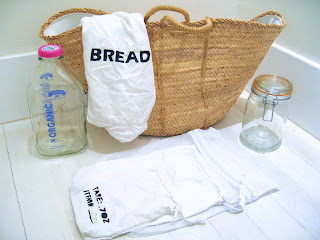
- Always have a few shopping baskets in your trunk: I like the straw French market baskets (I have lined them with an old sheet to make them stronger). One is filled with cloth and produce bags. I also have a rigid tote that I keep in a corner of the kitchen to store/carry milk and “wet items” jars to/from the grocery store.

- Use 2 sizes of cloth bags (10 of each should do) to transport grains and small items available in bulk (flour, sugar, beans, cereal, cookies, spices, etc…): You can buy these bags in the bulk section of your store (tucked in a dark corner…). Since I had a specific design idea in mind, I made mine from old sheets, with a fabric tie to eliminate metal ties, with their tare stamped on, and with a washable marker handy to note the item number directly on the fabric. I also use laundry mesh bags for produce (the cashier can read produce item numbers through it).
HOW: If your bags do not have a tare (weight of your empty bag) printed on them, they can be weighed at the customer service counter. In the bulk section, you then fill your bag and write its item number either on a tie (trash!) or directly on your bag (better, zero waste). At home, you'll pour your grains in see-through airtight containers. Don’t forget to put your cloth bags back in your shopping basket and car!

- Bring jars (French Le Parfait are my favorite) for wet items such as meat, fish, cheese, and deli from the counter or honey, peanut butter, pickles, etc from bulk: I like to use 1 liter jars for counter items (for my family of 2 adults and 2 kids, I use about 5 x 1liter jars a week: 2 meat, 1 fish, 1 cheese, 1 deli). Obviously life would be easier if we had succeeded in becoming vegetarians, and even easier if we were vegans (have not tried that yet).
HOW: For bulk items, get your jar weighed for its tare, fill it and write the item number on the available stickers. For counter items, simply ask the counter associate to fill your jar with your chosen, meat/fish/deli/cheese (the price sticker goes onto the jar and can be easily removed later). Some ask if your jar is clean, others ask why you’re doing this. After you've gone to the same store and talked to the same associates for consecutive weeks (same day of the week), they'll stop asking questions (see Difficult trip to WF) and you’ll get through shopping faster. Interesting fact: To this day, the Safeway cheese counter has never questioned my jars.

- Bring a large bread bag to the bakery for your bread order: I made a bag from the same old sheet.
HOW: I order my bread from Whole Foods Bakery as soon as I enter the store, I insist on no bread sleeve, and my baguettes bake while I shop. When I am done shopping, they slide the baguettes into my bag and give me one sleeve (for its barcode) to take to the store cashier with the rest of my groceries (make sure you refuse that sleeve! so they can reuse it and be reminded of the unnecessary packaging, see “what can my grocery store do to reduce packaging”). When I I get home, I binge on warm bread and freeze the rest… 15 baguettes every other week (incl. 2lbs of carbs on my belly)

- Refill liter or gallon size glass bottles with bulk castile soap, shampoo, conditioner, soy, vinegar, maple syrup...: I simply reuse empty 1 liter Whole Foods white vinegar bottles (I have not found white vinegar in bulk yet) for this purpose. I bought the gallon size at Rainbow grocery for olive and cooking oils.
HOW: These bottles also need to be weighed before you fill them with your chosen liquid and stick an item number on them. You won't be bringing these along to the store on a weekly basis. Bulk liquids are harder to find than counter products or grains, but once you find your supply, you’ll figure out your household monthly needs and the capacity of bottles needed. Again, the less you use on an everyday basis, the less you’ll need to refill, the smaller your footprint.

- Buy milk that comes in a glass jar: Depending on where you live you can either get it from a local dairy with delivery service or simply find your nearest Straus vendor. I get mine from Whole foods (your regular grocery store does not want to bother with the hassle of bottle redemption). With a recyclable cap and ring, the bottle can be returned to the store and then to the producer for reuse. I like to leave the cap on, it keeps the rinsing water in and reminds Straus to come up with a non-plastic cap.
HOW: If you buy Straus from your dairy aisle, you'll be charged a $1.50 deposit on your grocery bill. When you've drank all the yummy cream top milk, you rinse the bottle, take it back to your store (or any Straus vendor)'s customer service for a store credit slip.

- Bring your jar or cloth bag to a specialty store for a refill, such as ice-cream, candy, dog food: OK, this one is not easy, and will get you the most turn downs. But business in a jar is still business! And many are open to it
HOW: Choose a small business, Rite Aid will not refill your jar with ice cream (they are bound to too many corporate rules, but, hey, that's for the better: I doubt of its ice cream quality anyways). A small family-owned store will most likely accept. My local gelato joint has done so. For health license reasons, they have to sterilize my jar before filling it, which means that I have to drop it off and pick it up a few hours later. It does not come cheap and one cannot binge on ice cream (PMS) at this price, but the ingredients, seasonal flavors and palate excitement are worth every penny.

- Shop at the farmers market for (1) the egg stand who takes back its empty egg cartons, and (2) the sticker free produce!

- Refill your clean empty wine bottles with your everyday wine at a local winery bottling event: We like the reuse screw top wine bottles for this, no corks wasted. I’ll go into detail later about the 2 wineries I found locally, wine refilling is hard to find.
HOW: Research/contact wineries about refilling your bottles. The one winery that we like most, offers a bottling event 4 times a year. This is how they organize it: You are greeted at a table and fill a form, then move to the cashier counter and pay for the amount of bottles that you brought, then move to bottling: bottle line up, wine filling, corking or screwing, and labeling. We forego the latter, unlabeled wine is a more sustainable wine. It’s also a great way to start people talking about Zero Waste at a dinner party.

- Bring a refillable beer jug to your local brewery: some breweries carry them. We only get beer on occasions, when we’re scheduled to entertain beer drinkers, since it goes flat faster than bottled.
HOW: Look for a local brewery that will provide such service. Call around. If you get turned down, your inquiring will at least get them thinking about it. At my local brewery, I choose my beer from a long menu, the bartender fills the jug from the chosen beer tap and I pay for it, all at the counter.

One item at a time, you can "Zero Waste" your grocery shopping too.

Got milk? ... (in a glass jar only, please)